


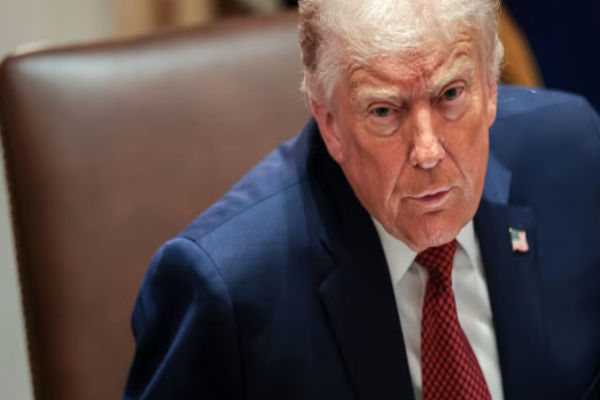
The executive order, titled Ensuring a National Policy Framework for Artificial Intelligence, marks the administration’s most assertive step to date. On December 11, President Donald Trump signed the order to limit state-level AI regulations and fast-track the development of a cohesive federal policy framework.
Titled Ensuring a National Policy Framework for Artificial Intelligence, the order signals the administration’s strongest effort yet to prevent what it describes as a “patchwork” of state regulations that could undermine the United States’ leadership in AI development.
In the order, Trump emphasizes that the U.S. is “in a race with adversaries for supremacy” in AI and stresses that businesses should be able to innovate “without cumbersome regulation.
He specifically criticizes emerging state laws that aim to regulate algorithmic discrimination, transparency, and AI model outputs.
Referencing Colorado’s recently enacted regulations, the president asserts that such laws “may even force AI models to produce false results to avoid a ‘differential treatment or impact’ on protected groups.
The executive order creates an AI Litigation Task Force within the Justice Department, tasked with challenging state laws that the administration considers unconstitutional or obstructive.
The order also directs the Commerce Department to release, within 90 days, an assessment highlighting state AI laws deemed “onerous” or at odds with federal policy.
Trump’s directive additionally urges the Federal Communications Commission (FCC) and the Federal Trade Commission (FTC) to develop federal reporting and disclosure standards that would explicitly override conflicting state regulations.
The order declares, “It is the policy of the United States to maintain and strengthen the nation’s global AI leadership through a minimally burdensome national policy framework.
The administration plans to submit a legislative proposal to Congress to create a federal AI framework that supersedes state regulations, while preserving state authority in areas such as child safety and government procurement.
Trump emphasized, “We remain in the earliest days of this technological revolution,” adding that “it is imperative that we act now to ensure that America wins the AI race.
The order arrives amid growing tensions between state governments and the federal administration over the regulation of AI.
In recent months, state-level scrutiny has intensified, with 42 attorneys general including those from Colorado, Florida, Massachusetts, Texas, Virginia, Washington, and Illinois warning that generative AI systems may already be infringing on consumer-protection and child-safety laws.
The bipartisan group has also called for independent audits of Microsoft, Google, Meta, and Apple, contending that developers have not done enough to prevent harmful or misleading AI outputs.
State legislatures have likewise acted swiftly to establish their own AI regulations, contributing to the “patchwork” that the White House now aims to dismantle.
California enacted the Transparency in Frontier Artificial Intelligence Act, mandating that developers of large-scale AI systems disclose risk assessments and safety documentation.
Texas took a different route, introducing criminal penalties for the possession or distribution of AI-generated obscene material involving minors.