



Introduction
For two decades, the defining feature of the internet was its borderlessness. A startup in Silicon Valley could serve a customer in Mumbai or Munich with the same code, the same database, and the same centralized infrastructure. The digital world was flat, frictionless, and theoretically unified.
That era is officially over.
As we move deeper into 2025, we have entered the age of the “Splinternet”, a fragmented web where digital borders are becoming just as rigid, and arguably more complex, than physical ones. Driven by national security concerns, economic protectionism, and privacy advocacy, nations are rapidly erecting “Digital Sovereignty” laws that fundamentally alter how the internet works.
For global enterprises, this is not just a policy nuisance or a legal checkbox; it is an existential infrastructure challenge. The strategy of “build once, deploy everywhere” is now a liability. To survive in this new landscape, businesses must transition from being “Global” to being “Multi-Local.”
The Three Pillars of Digital Sovereignty
Digital sovereignty is often dismissed by Western observers as mere censorship (like the Great Firewall of China), but the reality is far more nuanced and widespread. Governments today are exerting control through three distinct mechanisms that every CTO must understand:
1. Data Localization
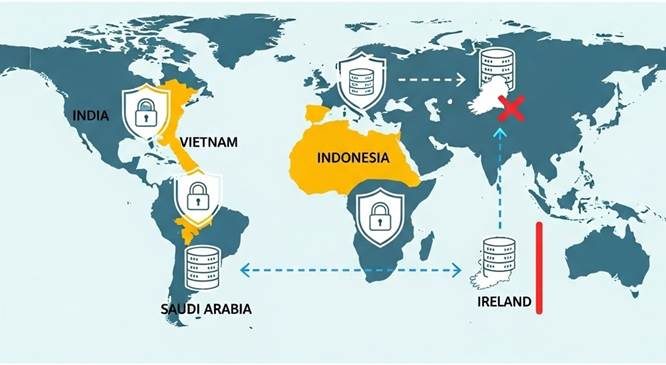
The most aggressive shift in 2024 and 2025 has been the rise of strict data localization laws. It is no longer just about China.
- India: The Digital Personal Data Protection Act (DPDP) now mandates that specific categories of critical user data cannot leave Indian soil without rigorous government approval.
- Vietnam: The new Cybersecurity Law requires foreign tech companies to store user data locally and open local representative offices.
- Indonesia & Saudi Arabia: Both have enacted public sector data mandates that essentially force vendors to build local data centers if they wish to bid on government contracts.
You can no longer simply host your Saudi user data in an AWS data center in Ireland to save costs. It must reside on a server in Riyadh. This forces companies to fragment their databases, complicating analytics and increasing storage costs exponentially.
2. The “Sovereign Cloud”

The European Union, through initiatives like GAIA-X and strict interpretations of GDPR (post-Schrems II), is pushing for a cloud infrastructure that is immune to the US CLOUD Act. The fear is that US intelligence agencies could subpoena data stored by American providers (AWS, Azure, Google), even if that data sits on a server in Frankfurt.
This has birthed the “Sovereign Cloud” market, projected to grow to nearly $800 billion by 2032. Hyperscalers are responding by building “air-gapped” regions—partnerships with local telecoms (like T-Systems in Germany or Orange in France) where the control plane is legally and operationally isolated from the global network. For a global enterprise, this means your German cloud instance might behave differently, have different APIs, and cost 20% more than your US instance.
3. Network Autonomy (The “Kill Switch”)

Nations are increasingly building domestic routing capabilities to ensure their internal internet can function even if cut off from the global web. Russia has successfully tested its “Runet,” effectively disconnecting from the global internet while keeping internal banking and media online. Other nations are watching closely, investing in domestic internet exchange points (IXPs) and forcing ISPs to peer locally rather than routing traffic through international hubs like London or Singapore.
The Infrastructure Nightmare: Why “Latency” is Now a Legal Term
This fragmentation creates a massive headache for technology leaders. Ten years ago, a CTO’s primary goal was consolidation: How do we centralize everything into one efficient cloud region? Today, the goal is distribution: How do we fragment our stack to comply with 50 different jurisdictions without going bankrupt?
The costs are staggering. Maintaining compliant infrastructure in a dozen countries means duplicating databases, managing distinct encryption keys for every region, and navigating a labyrinth of compliance audits.
Moreover, the penalties for failure are rising. We aren’t just talking about fines (though GDPR fines can reach 4% of global revenue). We are talking about market exclusion. If your payment gateway doesn’t route transactions locally in India, you don’t just pay a fine—you are blocked from processing payments entirely.
The “IP Address” Crisis: You Can’t Fake Geography Anymore
One of the most overlooked aspects of this shift is the role of the humble IP address.
In the past, companies would often “fake” a local presence using CDNs or generic Anycast IPs. A user in Brazil might connect to a service that looked local but was actually resolving to a server in Miami.
Regulators have caught up. New compliance frameworks often require “Sovereign IP Addressing”. This means that to operate a licensed fintech app in Nigeria or a gaming platform in Vietnam, the ingress and egress traffic must flow through IP addresses registered to a local entity and physically announced via local BGP (Border Gateway Protocol) sessions.
This has created a massive supply crunch. IPv4 addresses are exhausted globally, but the demand for specific regional blocks is skyrocketing. A “generic” US-based IP is becoming a liability in emerging markets, serving as a red flag for regulators and a latency killer for users.
Smart infrastructure teams are now treating IP blocks as strategic assets. They aren’t just buying bandwidth; they are acquiring dedicated, clean IP ranges in specific geolocations—São Paulo, Jakarta, Lagos—to ensure they have a verified digital footprint inside the sovereign borders of their target markets.
Strategic Pivot: The “Multi-Local” Architecture
So, how do global companies adapt? The answer lies in abandoning the “Global” mindset and adopting a “Multi-Local” Architecture.
1. Decentralized Edge Computing
Instead of backhauling traffic to a central hub in Virginia or Frankfurt, companies are moving logic to the edge. By deploying application servers inside the target country (using bare metal or local cloud providers), you satisfy latency demands and often solve basic data residency requirements. The “edge” is no longer just about speed; it’s about compliance.
2. Localized Partnership Ecosystems
You cannot go it alone. The regulatory landscape changes too fast. Successful companies are partnering with local infrastructure specialists—regional ISPs, local data center operators, and IP management firms—who understand the terrain. These partners can navigate the local RIR (Regional Internet Registry) policies and ensure your network resources are compliant with the latest “Ministry of Communications” decree.
3. Market Intelligence as Infrastructure
Technology moves fast, but policy moves in sudden, disruptive jerks. One day a market is open; the next day a new “Data Protection Bill” passes, and you have six months to migrate or exit.
This is where specialized market intelligence becomes a critical infrastructure asset. Relying on mainstream tech news is often too slow. Technology leaders need deep-dive analysis on how subsea cables are being routed, where new sovereign data centers are breaking ground, and how telecom policies are shifting.
For instance, deep-dive analysis on global infrastructure trends by BTW Media highlights that investment in “sovereign” data centers in emerging markets (Tier 2 and Tier 3 regions) has outpaced traditional hubs for the first time this decade. This shift signals that smart capital is betting big on a fragmented future, and CTOs should follow the money.
The Silver Lining: Trust as the New Currency
While the Splinternet imposes costs, it also offers a hidden competitive advantage: Trust.
In an era of cyberwarfare, surveillance anxiety, and corporate espionage, customers want to know their data is safe at home.
- A German enterprise prefers a vendor who guarantees their data never leaves Frankfurt.
- An Indonesian consumer trusts a fintech app that routes locally over one that pings a server in Singapore.
- A Brazilian healthcare provider is legally bound to use services that guarantee sovereignty.
By embracing the Splinternet—by building a truly Multi-Local infrastructure—you aren’t just checking a compliance box. You are signaling to local markets that you are a permanent, respectful, and trustworthy player in their digital economy. You are saying: “We are not just extracting value from your country; we are building infrastructure within it.”
Conclusion
The dream of a single, borderless internet is behind us. We are now navigating a world of federated networks, distinct regulatory zones, and sovereign digital territories.
For global business, the choice is stark: cling to the centralized models of the past and risk being locked out of key markets, or embrace the complexity of the Splinternet. The future belongs to those who can think globally, but route locally.