

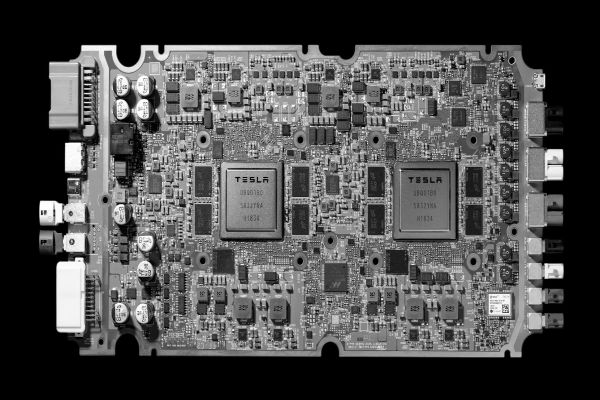
Tesla plans to release initial samples and limited production units of its AI5 chips in 2026, with full-scale mass production targeted for 2027.
Elon Musk revealed that Tesla intends to begin limited production of its AI5 chips in 2026, followed by large-scale manufacturing in 2027. The production will be handled by leading semiconductor giants TSMC and Samsung.
Musk said in a post on X that slightly different versions of the AI5 chip will be produced at each facility. “They translate designs to physical form differently, but the goal is that our AI software works identically,” he explained.
Tesla is simultaneously working on its next-generation AI6 chip, which will be manufactured at the same facilities as the AI5. According to Musk, the new chip is projected to offer nearly double the performance and may enter large-scale production around mid-2028.
In contrast, the upcoming AI7 chip will be built in separate fabrication plants due to its completely redesigned architecture. Musk referred to it as a “more experimental” project, noting that while it represents a bold step forward, there’s no confirmed schedule for its production yet.
Earlier this year, Tesla confirmed that the AI6 chips will be produced at Samsung’s new foundry in Taylor, Texas. This phase will begin after Samsung completes production of the AI4 chips and TSMC starts work on the AI5 series.
The move fits into Tesla’s broader strategy to enhance its AI and autonomous driving technologies. By partnering with both TSMC and Samsung, the company aims to boost performance, expand scalability, and reduce dependence on any single supplier in its chip manufacturing ecosystem.
In a post shared on September 7, Musk stated that the AI5 chip is expected to be the top-performing inference chip for models under roughly 250 billion parameters. He highlighted that it offers exceptional efficiency, delivering the best performance per watt at the lowest silicon cost.
Musk further noted that the upcoming AI6 chip will significantly advance these capabilities.
He also pointed out the shift in Tesla’s chip design strategy, explaining that consolidating efforts into a single architecture allows the company’s silicon team to concentrate fully on building one outstanding chip.