


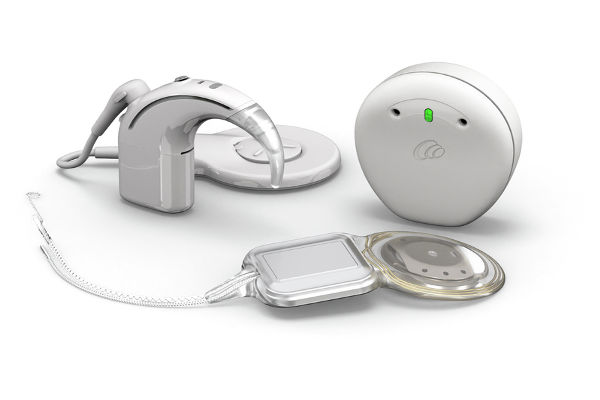
The next frontier for edge AI in medical devices is no longer limited to wearables or bedside monitors it’s now inside the human body. Cochlear’s newly launched Nucleus Nexa System is the first cochlear implant designed to run machine learning algorithms on-device while operating under extreme power constraints. It can store personalized data locally and receive over-the-air firmware updates, allowing its AI models to improve continuously over time.
For AI practitioners, the technical challenge is immense: they must develop a decision-tree model capable of classifying five distinct auditory environments in real time, optimize it to run on a device with an extremely limited power budget that could last decades, and achieve all of this while interfacing directly with human neural tissue.
Smart Listening: Decision Trees on Ultra-Low-Power Implants
At the heart of the Nucleus Nexa System is SCAN 2, an advanced environmental classifier. It processes incoming audio in real time and categorizes sounds into five distinct environments: Speech, Speech in Noise, Noise, Music, or Quiet, enabling the implant to adapt instantly to the wearer’s surroundings.
These classifications are fed into a decision tree, a type of machine learning model,” explains Jan Janssen, Cochlear’s Global CTO, in an exclusive interview with AI News. “The model then adjusts the sound processing settings for each environment, fine-tuning the electrical signals delivered to the implant for optimal hearing.
While the model primarily runs on the external sound processor, the implant itself also contributes through Dynamic Power Management. An enhanced RF link interleaves data and power between the processor and implant, enabling the chipset to optimize energy usage based on the ML model’s environmental classifications.
This goes beyond smart power management it’s a breakthrough in edge AI for medical devices, tackling one of the toughest challenges in implantable computing: how to keep a device running reliably for over 40 years when its battery cannot be replaced.
Spatial Intelligence: Targeting Sound Amid Noise
Beyond classifying environments, the Nucleus Nexa System uses ForwardFocus, a spatial noise algorithm that leverages input from two omnidirectional microphones to map target and background sound patterns. The algorithm assumes desired signals come from the front while noise originates from the sides or behind, applying spatial filtering to reduce unwanted background interference.
From an AI perspective, what makes this remarkable is the automation layer. ForwardFocus operates autonomously, reducing the cognitive burden on users navigating complex auditory environments. The system decides when to activate spatial filtering based on its environmental analysis completely without user intervention.
Upgradeable AI: Redefining Cochlear Implants
The real breakthrough lies in the implant’s upgradeable firmware. Traditionally, once a cochlear implant was surgically implanted, its capabilities were fixed. Advances in signal processing, improved machine learning models, and enhanced noise reduction could not be applied to existing patients until now.
The Nucleus Nexa Implant transforms this limitation. Using Cochlear’s proprietary short-range RF link, audiologists can deliver firmware updates from the external processor directly to the implant. Security is ensured through physical constraints the limited transmission range and low power output require close proximity during updates alongside protocol-level safeguards.
With these smart implants, a copy of the user’s personalized hearing map is stored directly on the implant,” Janssen explained. “If the external processor is lost, we can provide a replacement, and it will automatically retrieve the map from the implant.
The implant can store up to four unique hearing maps in its internal memory. From an AI deployment standpoint, this addresses a key challenge: how to preserve personalized model parameters when hardware components fail or are replaced.
From Decision Trees to Deep Neural Networks: The Future of AI Hearing
Cochlear’s current system relies on decision tree models for environmental classification, a practical choice given the strict power limits and the need for interpretability in medical devices. Looking ahead, Janssen highlighted the next frontier: “In the future, deep neural networks a more sophisticated form of machine learning may further enhance hearing performance in challenging, noisy environments.”
Networks: The Future of AI Hearing
The company is also looking beyond signal processing for AI applications. “Cochlear is exploring how artificial intelligence and connectivity can automate routine check-ups and help lower lifetime care costs,” Janssen noted.
This signals a broader evolution for edge AI in medical devices: moving from reactive signal processing to predictive health monitoring, and from manual clinical adjustments to autonomous optimization.
The Edge AI Challenge in Implantable Devices
Power: The device must operate for decades on minimal energy, with battery life measured in full days despite continuous audio processing and wireless transmission.
Latency: Audio processing occurs in real time with imperceptible delay users cannot tolerate lag between speech and neural stimulation.
Safety: As a life-critical medical device directly stimulating neural tissue, any model failure can impact quality of life.
Upgradeability: The implant must accommodate model improvements over 40+ years without hardware replacement.
Privacy: Health data is processed on-device, with rigorous de-identification applied before inclusion in Cochlear’s Real-World Evidence program, which leverages data from over 500,000 patients for model training.
These constraints drive architectural choices rarely seen in cloud or smartphone ML deployments. Every milliwatt of power counts, every algorithm must meet strict medical safety standards, and every firmware update must be flawless.
Beyond Bluetooth: Toward Connected, Smart Implants
Looking forward, Cochlear is introducing Bluetooth LE Audio and Auracast broadcast capabilities, which will be enabled through future firmware updates. These protocols deliver higher audio quality with lower power consumption and, crucially, position the implant as an integrated node within wider assistive listening networks.
Auracast broadcast audio enables direct connections to audio streams in public spaces such as airports, gyms, and theaters. This transforms the implant from a standalone medical device into a connected edge AI system, actively interacting with ambient computing environments.
The long-term vision envisions fully implantable devices with built-in microphones and batteries, removing the need for any external components. At that stage, these implants would function as fully autonomous AI systems within the human body adapting to environments, optimizing power, managing connectivity, and operating entirely without user intervention.
The Edge AI Medical Device Blueprint
Cochlear’s approach provides a roadmap for developing edge AI medical devices under extreme constraints: begin with interpretable models such as decision trees, optimize rigorously for power efficiency, design upgradeability from the outset, and plan for a 40-year operational horizon rather than the typical 2–3 year consumer device cycle.
As Janssen highlighted, the smart implant launching today “is just the first step toward an even smarter device.” For an industry accustomed to rapid iteration and continuous deployment, balancing decade-long product lifecycles with ongoing AI advancement presents a compelling engineering challenge.
The question isn’t if AI will transform medical devices Cochlear’s deployment shows it already has. The real challenge is how quickly other manufacturers can overcome these constraints and deliver similarly intelligent systems to market.
For the 546 million people living with hearing loss in the Western Pacific Region alone, the speed of this innovation will decide whether AI in medicine remains a prototype or becomes a standard of care.