


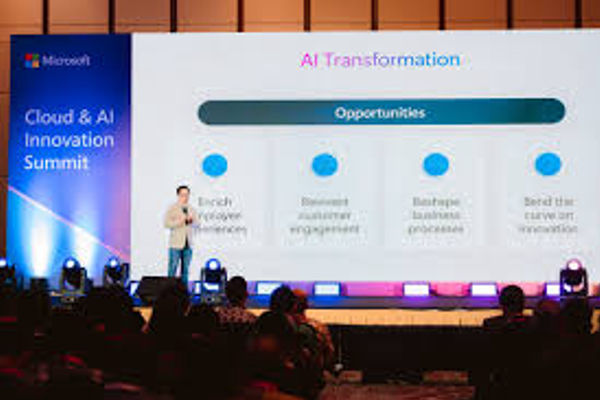
Indonesia’s drive for AI-powered growth is accelerating as local organizations increasingly seek to develop applications, modernize their systems, and enhance data governance. With Microsoft expanding services in the Indonesia Central cloud region which launched six months ago businesses, government agencies, and developers now have greater flexibility to run AI workloads domestically rather than relying on overseas data centers.
The announcement came during the Cloud & AI Innovation Summit in Jakarta, where business and government leaders gathered to explore ways to accelerate Indonesia’s AI initiatives. Key speakers included Mike Chan, head of Azure AI Apps & Agents in Asia, and Dharma Simorangkir, President Director of Microsoft Indonesia. They emphasized that building local capabilities is valuable only when organizations actively leverage them.
At the event, Dharma highlighted that the new services ‘open the door for every organization to innovate in Indonesia, for Indonesia,’ urging teams across various sectors to create solutions addressing the country’s key challenges.
From Adoption to Innovation: Indonesia’s AI Frontier
Many Indonesian companies are now going beyond simple AI experiments, actively developing solutions tailored to their specific operational challenges. Microsoft refers to these organizations as ‘Frontier Firms’ teams that integrate AI into the heart of their operations rather than treating it as an optional tool. These firms prioritize building applications that enhance customer experiences, streamline internal processes, and modernize legacy workflows.
To support this transition, the Indonesia Central region now offers a wide range of Azure services that enable teams to design and deploy software efficiently. These include tools for building data-connected applications, services for storing and managing structured data, and AI-ready virtual machines capable of training and running advanced models. High-performance computing machines let teams process complex AI workloads while keeping data within the country.
The region also supports Microsoft 365 Copilot, bringing AI capabilities to everyday work applications. Developers can leverage GitHub Copilot, which suggests code and accelerates software development. Together, these services create an integrated stack that helps organizations move beyond small-scale pilots and into full production, where reliability, scalability, and cost management are critical.
Microsoft Cloud Projects Gain Traction in Indonesia
The expansion of Microsoft’s cloud region in Indonesia follows strong demand since its launch in May 2025. Companies in sectors such as mining, travel, and digital services are already leveraging local cloud infrastructure to modernize legacy systems and meet increasingly stringent data governance requirements.
Petrosea and Vale Indonesia are two examples of companies using the region to support technical upgrades and ensure secure local data storage. Additionally, digital-first companies are exploring deeper AI integration. For instance, tiket.com developed its own AI-powered travel assistant using the Azure OpenAI Service, enabling customers to interact with the platform in natural language from checking flight updates to customizing bookings with additional services.
Our advancements in artificial intelligence are designed to deliver the best possible experience for our customers,’ said Irvan Bastian Arief, PhD, Vice President of Technology GRAND, Data & AI at tiket.com.
The company views conversational AI as a key tool to simplify travel planning and minimize friction in customer support.
Consolidating Data for Scalable AI Adoption
A key takeaway from the summit was the importance of organizing data before scaling AI adoption. To support this, Microsoft introduced Microsoft Fabric to the Indonesian market. Fabric is an integrated platform that combines data engineering, integration, warehousing, analytics, and business intelligence in one environment. It features Copilot tools that help teams prepare data and generate insights without the need for multiple disconnected tools.
For many organizations, data is scattered across various internal systems and cloud providers. Fabric offers a unified platform to consolidate these sources, which can help improve data governance, accelerate reporting, and better manage costs. It’s designed for teams that want structure without having to build their data foundation from the ground up.
Empowering Indonesia’s Workforce with Practical AI Training
“The summit’s focus extended beyond infrastructure to include workforce development. Microsoft highlighted its AI training initiative, Microsoft Elevate, which is now in its second year. The program has already reached over 1.2 million learners and aims to certify 500,000 people in AI skills by 2026. The next phase will emphasize hands-on experience, encouraging participants to apply AI in real-world scenarios rather than just learning theoretical concepts.
The training targets a diverse range of groups, including teachers, nonprofit workers, community leaders, and individuals looking to improve their digital literacy. Participants engage with tools like Microsoft Copilot, Learning Accelerator, Minecraft Education, and other modules designed to showcase how AI can assist in practical tasks.
During the summit, Dharma emphasized that cloud and AI are ‘the backbone of national competitiveness,’ stressing that infrastructure is only valuable if people are equipped to use it.
Building a Sustainable AI Ecosystem in Indonesia”
This initiative is part of a broader commitment of US$1.7 billion that Microsoft has pledged for Indonesia between 2024 and 2028. The investment covers infrastructure, partner support, and talent development. Additionally, Microsoft is preparing to host GitHub Universe Jakarta on 3 December 2025, a developer-focused event designed to foster collaboration among software teams, startups, and researchers.
Indonesia aims to establish itself as a hub for secure and inclusive AI development in the region. With the expansion of the Indonesia Central cloud region, new AI and data tools, and an increasing focus on workforce training, the country is laying the groundwork for long-term digital growth. Companies now have the opportunity to build AI systems locally, developers have access to more resources, and workers have additional pathways to gain practical skills.
As Indonesia moves from AI experimentation to large-scale adoption, the coming years will reveal how these various elements come together to shape the nation’s digital future.”